
Guide
XCMG XE750GK 75-Tonne Excavator: Specs, Configurations & Quote Price
Engine reserve, digging force, working range, undercarriage life and transport cost for the 76.5-tonne XE750GK, read together rather than as a single headline number.
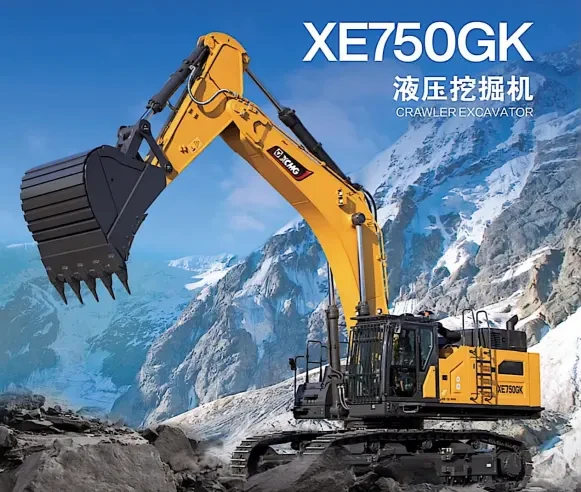
A 76.5-tonne crawler excavator is not bought on a single headline number. Buyers in mining, quarrying and large earthworks compare engine reserve, digging force, reach, undercarriage life and transport cost together. The XCMG XE750GK sits in the 75-tonne class with a 5.2 m³ rock bucket, and its published specification sheet shows where the machine is designed to work and where it will not.
XCMG positions the XE750GK for hard digging: rock stripping, ore loading, limestone and sandstone quarries, and large-scale earthmoving. The figures below come from XCMG’s published model data and dealer specification tables. Configuration varies by market, so a buyer should confirm the final sheet for the exact build before ordering.
Engine and power delivery
The XE750GK uses a Cummins QSM15 six-cylinder diesel rated at 563 kW at 2,000 rpm. Displacement is 14.5 litres, with peak torque of 2,900 N·m at 1,200 rpm. That torque curve matters more than peak power in a loading cycle: the engine reaches maximum pull at low engine speed, which supports hydraulic response when the bucket is working through rock.
XCMG says the engine is customised for this model and does not require urea injection. That simplifies fluid logistics on remote sites, where diesel exhaust fluid supply can be a genuine constraint. The manufacturer also lists high-altitude adaptability. Buyers working at elevation should still ask for the altitude configuration and any derating data for the exact build, because cooling and fuel mapping are not identical across markets.
Digging force and working range
Bucket digging force is 405 kN, and arm digging force is 365 kN. Maximum tractive force is 547 kN. These numbers determine how the machine handles compacted overburden, fractured rock and heavy bucket loads without stalling the cycle. They also explain the model’s place in the range: it is a production tool for hard material, not a general-purpose digging machine.
The working range is equally relevant to fleet planning. Maximum digging radius is 12,050 mm, maximum digging depth is 7,400 mm, maximum digging height is 11,280 mm, and maximum dump height is 7,320 mm. A 7,000 mm boom and a 2,850 mm arm are listed for the standard configuration. The combination suits bench loading where the truck spot is fixed and the operator needs reach without repositioning the carrier.
Hydraulics and undercarriage
The main hydraulic system runs two variable pumps at 434 L/min each, with main relief pressure of 34.3 MPa and a maximum of 37 MPa. Swing pressure is 32 MPa, travel pressure is 34.3 MPa, and pilot pressure is 3.9 MPa. For a machine of this size, hydraulic capacity is the real limit on simultaneous travel, swing and digging functions, so the pump figures deserve more attention than the engine rating alone.
The undercarriage uses a 260-pitch chain, 650 mm track shoes, eight lower rollers per side and 48 links per side. Ground pressure is listed at 112 kPa. Minimum ground clearance is 900 mm, tail swing radius is 4,120 mm, and the track gauge extends from 2,840 mm in transport mode to 3,410 mm in working mode. Travel speed is 4.5 km/h in high range and 2.8 km/h in low range; swing speed is 7.3 rpm; gradeability is 35 degrees.
Transport, fuel and daily operation
The machine ships at roughly 12,650 to 12,905 mm long, 4,420 mm wide and 3,960 to 4,505 mm high, depending on configuration. At 76.5 tonnes, it moves as break-bulk, RoRo or flat-rack cargo, not in a standard container. Transport planning should start before the purchase order, because port handling, road permits and crane capacity at destination all depend on the final dimensions and attachment set.
Fuel capacity is 910 litres, with a 450-litre hydraulic tank. The 10.1-inch touchscreen groups more than 100 functions, and the ISSA control system manages swing and pump output to reduce energy loss. XCMG rates the mining-type working device at more than 12,000 hours, and the track shoe bolts are strengthened to a level the manufacturer compares with the 90-tonne class.
Where the XE750GK fits
The model earns its cost in high-duty-cycle work. A 5.2 m³ rock bucket matched to 405 kN of bucket force moves large volumes per pass, and the 12,050 mm reach keeps the carrier on stable ground while the bucket loads the truck. In a quarry or a mine bench, that combination reduces repositioning time and keeps the loading tool close to the face.
The same size becomes a liability in smaller sites. Transport weight, width and tail swing set a minimum working envelope, and the hydraulic system needs a duty cycle that keeps oil temperature in range. A contractor moving between scattered sites should price mobilization before comparing purchase prices, because moving a 76.5-tonne machine is a recurring cost, not a one-off.
Material also decides the attachment. Rock buckets, heavy-duty buckets and reinforced wear packages are not interchangeable, and the bucket supplied with the machine should match the abrasiveness and fragmentation of the rock. Buyers should confirm bucket volume, tooth type and wear protection on the final quotation rather than on a brochure.
How to read the specification before buying
The published sheet gives a reliable baseline, but three details decide the real cost of ownership. The first is the emission package and documentation required at the destination port. The second is the undercarriage condition on any used unit: track shoe height, link wear, roller and idler play, and sprocket wear. The third is hydraulic performance measured against OEM specification, not against the seller’s description.
For used units, our six-stage inspection covers identity and service history, engine and drivetrain, hydraulics, undercarriage and structure, function and load testing, and documents. The report includes 40 to 60 photos and a walkthrough video before deposit. For new units, we confirm factory configuration, shipping method and export documentation before the order is placed.
Request a quote
Our export team has sold construction machinery from China for 35 years and shipped to more than 100 countries. To price an XE750GK for a specific job, send the working conditions, destination port and preferred configuration. We will reply with availability, shipping options and a delivered quote within 24 hours.
Phone and WhatsApp: +86 13764468035. Email: shunfa@usedexcavator.shop. Location: Anhui, China.
Request a quote for this machine
Send the destination port, bucket or breaker configuration and preferred year range. We reply within 24 hours with matching units, photos and a delivered price.