Guide
XCMG XE380G PRO Specifications: Configuration and Quote Price
Power, emissions, hydraulic performance and working range for the 38-tonne XE380G PRO, plus the four inputs a firm quotation needs.
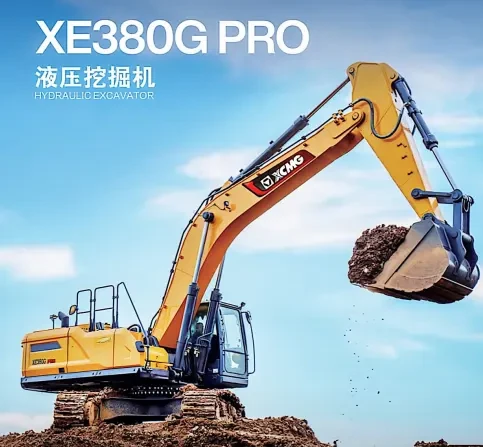
The 38-tonne crawler class is where fleet economics change. Below it, machines move material; at this size, cycle time, bucket fill and hydraulic response begin to decide whether a quarry or a road project keeps its schedule. The XCMG XE380G PRO is built for that segment: mass excavation, truck loading in aggregate pits, mine stripping and large infrastructure work.
Published XCMG data places the machine at roughly 38.3 tonnes, with a 210 kW engine and a 1.9 m³ rock bucket as standard. The figures below come from XCMG’s published project information and configuration sheets. Final values vary by market, emission version and attachment package, which is why a quotation has to be tied to a specific build.
Power and emission control
The XE380G PRO uses an Isuzu 6HK1 series six-cylinder diesel, turbocharged and intercooled, with high-pressure common-rail injection. Rated output is 210 kW at 1,900 rpm and peak torque is 1,080 N·m at 1,500 rpm. Displacement is 7.79 litres.
The engine meets China Stage IV and Tier 4 final in the published export configuration. XCMG’s case material notes a DPD particulate aftertreatment system that does not require urea, which removes the AdBlue supply line from the site’s daily routine. For contractors working in remote areas, that is a maintenance decision as much as an emissions one. The same material states the power unit holds output at high altitude, a claim worth testing against the specific job site elevation before purchase.
Hydraulic system and digging performance
XCMG fits two variable-displacement piston pumps with a combined rated flow of 2 × 306 L/min. Main relief pressure is 34.3 MPa, rising to 37 MPa under boost. Pilot pressure is 3.9 MPa.
Flow and pressure set the ceiling on working speed; the control layer decides how much of that ceiling the operator actually uses. The PRO uses XCMG’s PIC feed-forward control, which reads load demand and adjusts pump output before the resistance reaches the cylinders. In a truck-loading cycle, the practical result is a shorter pause at the bucket-to-truck transfer and a fuller bucket at each pass.
Published digging forces are 263 kN at the bucket and 213 kN at the arm. Maximum traction force is 305 kN. Swing speed is 9.9 rpm, travel speed is 5.6 km/h in high range and 3.3 km/h in low, and gradeability is 35 degrees. Ground pressure with 600 mm shoes is about 69.5 kPa.
Working range and dimensions
The standard working device is a 6,400 mm boom with a 2,900 mm arm. A 2,670 mm arm is listed as an option, and it trades reach for breakout at the bucket.
| Parameter | Published value |
|---|---|
| Operating weight | 38,300 kg (38,700 kg in some configurations) |
| Standard bucket | 1.9 m³ rock bucket |
| Optional bucket | 2.1 m³ earthmoving bucket |
| Max digging depth | 7,145 mm |
| Max digging radius | 10,970 mm |
| Max digging height | 10,508 mm |
| Max dumping height | 7,300 mm |
| Overall length × width × height | 11,265 × 3,190 × 3,760 mm |
| Track shoe width | 600 mm |
| Fuel tank | 575 L |
| Hydraulic oil tank | 345 L |
Transport planning deserves attention before the machine is ordered. At 11.3 m long and 3.19 m wide, the unit moves as a heavy abnormal load in most markets. The 3,760 mm height and 38-tonne class weight determine trailer selection, route permits and port handling.
Bucket, structure and undercarriage
The standard 1.9 m³ rock bucket uses side-tooth and wear-plate reinforcement. XCMG reports a 25% improvement in wear resistance over the previous design, a figure that matters in granite and broken basalt where bucket edges are a consumable. For earth and gravel loading, the 2.1 m³ bucket raises the payload per pass and shortens the cycle count per truck.
Boom and arm hinge points are strengthened to absorb impact and vibration. The undercarriage runs a 600 mm shoe on a track frame sized for continuous heavy work, with nine track rollers and two carrier rollers per side.
What determines the quotation
Two machines with the same model plate can differ by a five-figure sum. The variables that move price most are the emission version, the arm and bucket combination, attachment piping for a breaker or quick coupler, and the certification package required at the destination port.
Condition is the other variable. A new unit, a low-hour demonstration machine and a used unit with 5,000 hours sit in different price bands, and the inspection record matters more than the year stamp. SHUNFA Machinery inspects every unit across six stages before shipment, covering engine and drivetrain, hydraulics, undercarriage, structure, and function testing under load. Buyers receive a report with 40 to 60 photographs and a walkaround video before paying a deposit.
A firm quotation therefore needs four inputs from the buyer: the emission standard accepted in the destination country, the bucket and arm configuration, the attachment list, and the discharge port. With those, the sales team can confirm the build, the inspection record and the delivered cost.
Contact us for a quotation
SHUNFA Machinery has supplied construction equipment for more than 35 years and ships to over 100 countries. Send the four inputs above and the team will return a configuration-matched quotation within 24 hours, including shipping terms to the named port.
Phone: +86 13764468035. Email: shunfa@usedexcavator.shop.
Request a quote for this machine
Send the destination port, bucket or breaker configuration and preferred year range. We reply within 24 hours with matching units, photos and a delivered price.